
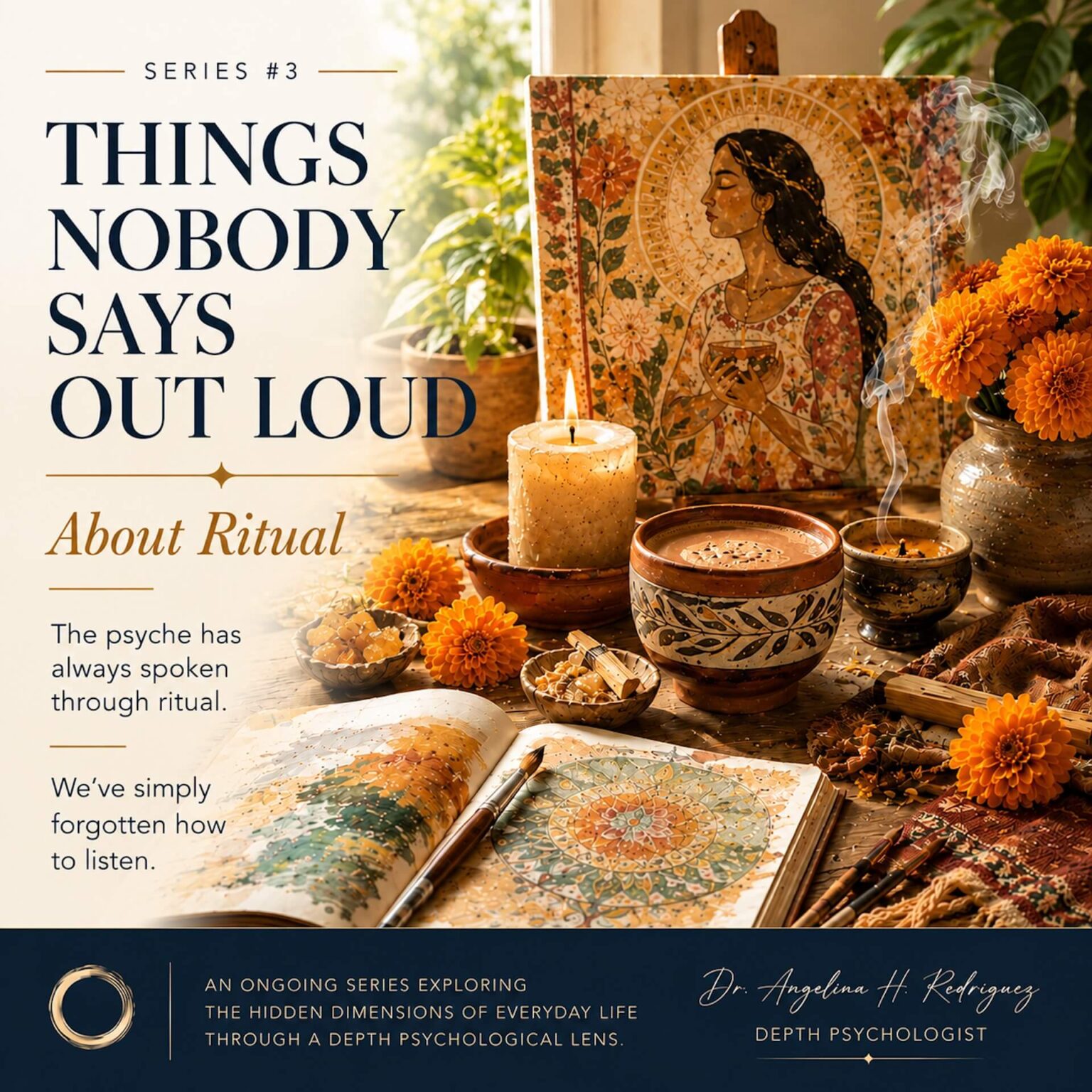
Reflections from a Depth Psychology Lens
There is something about ritual that many people quietly long for but rarely know how to name.
We light a candle after someone dies.
We visit the same place every anniversary.
We keep a letter in a drawer we cannot throw away.
We return to the ocean when life feels uncertain.
We place flowers beside a photograph.
We make coffee the way our grandmother once did.
Most of us dismiss these moments as habits.
The psyche does not.
One of the things nobody says out loud is this:
The human psyche has always spoken through ritual.
Long before there were psychotherapy offices, psychological assessments, or diagnostic manuals, human beings created rituals to help them navigate life’s most profound experiences—birth, love, illness, death, seasons of uncertainty, and transformation.
Ritual has never been simply about religion or tradition.
It has always been about relationship.
A relationship with ourselves.
A relationship with those we have loved.
A relationship with mystery.
And perhaps most importantly, a relationship with the unconscious.
As a depth psychologist, I have come to believe that one of the greatest losses in modern life is not simply the disappearance of rituals, but the disappearance of spaces where the psyche is invited to speak symbolically.
Today we are encouraged to solve problems quickly.
Move on.
Stay productive.
Find closure.
Yet the psyche rarely moves in straight lines.
It speaks through dreams.
Through images.
Through symbols.
Through creative acts.
Through ritual.
For more than twenty years I have watched people discover something remarkable when they are invited to engage symbolically rather than analytically.
Sometimes they paint what they cannot say.
Sometimes they dream the answer before they understand the question.
Sometimes they create an altar and discover they are no longer speaking about grief—they are in relationship with it.
This realization shaped not only my clinical work but also my doctoral research exploring the Día de los Muertos Ofrenda tradition as an art-based inquiry into complicated grief. Again and again, I witnessed that the creative and symbolic act of making became part of the healing itself.
More recently, I found myself once again becoming a student.
While traveling in Oaxaca, I had the privilege of learning about the cultural traditions surrounding ceremonial cacao. That experience continued through additional study, creative practice, and artistic reflection.
What interested me was not simply cacao.
It was ritual.
The quiet intention of preparing a cup.
The invitation to pause.
The willingness to sit with oneself before speaking.
The recognition that healing is often less about doing and more about becoming present.
As both a psychologist and an artist, I have learned that ritual changes us not because it is magical, but because it engages the imagination.
It slows ordinary consciousness long enough for another way of knowing to emerge.
This is why I integrate experiential journeys into my work. Whether through Jungian art therapy, dream work, or carefully held rituals, the goal is never performance or perfection. The invitation is to encounter the psyche through image, symbol, creativity, and reflection—to discover what may be asking for attention beneath the surface of everyday life.
James Hillman once reminded us that psychology begins with image.
Carl Jung taught that symbols transform us because they carry more meaning than our rational minds can immediately comprehend.
Art allows those symbols to become visible.
Ritual allows us to participate in them.
Perhaps this is why so many people instinctively create rituals during times of grief without ever realizing they are doing so.
The candle.
The photograph.
The favorite song.
The walk.
The garden.
The handwritten letter.
None of these erase suffering.
But they give suffering a place to live.
One of the greatest misconceptions is that ritual belongs only to ancient cultures.
I believe ritual belongs wherever human beings seek meaning.
Every time we intentionally create space to listen rather than simply react, we step into ritual.
Every time we honor memory through creativity, we step into ritual.
Every time we allow an image, a dream, or a symbolic act to reveal something we could not yet put into words, we step into ritual.
Perhaps the deepest truth is this:
Healing is not always found by asking, “How do I get over this?”
Sometimes healing begins by asking,
“What is this experience asking me to become?”
That is a question rituals have been helping humanity explore for thousands of years.
And perhaps they still are.
About the Author
Dr. Angelina H. Rodriguez is a Depth Psychologist, Jungian Art Therapist, Dream Therapist, presenter, and researcher with more than 20 years of clinical experience. Her work explores dreams, symbolism, grief, ritual, creativity, and psychological transformation. She is the author of doctoral research examining the Ofrenda ritual as a bridge between art, memory, grief, and healing, and regularly presents on depth psychology, Jungian thought, dream work, and symbolic healing.