
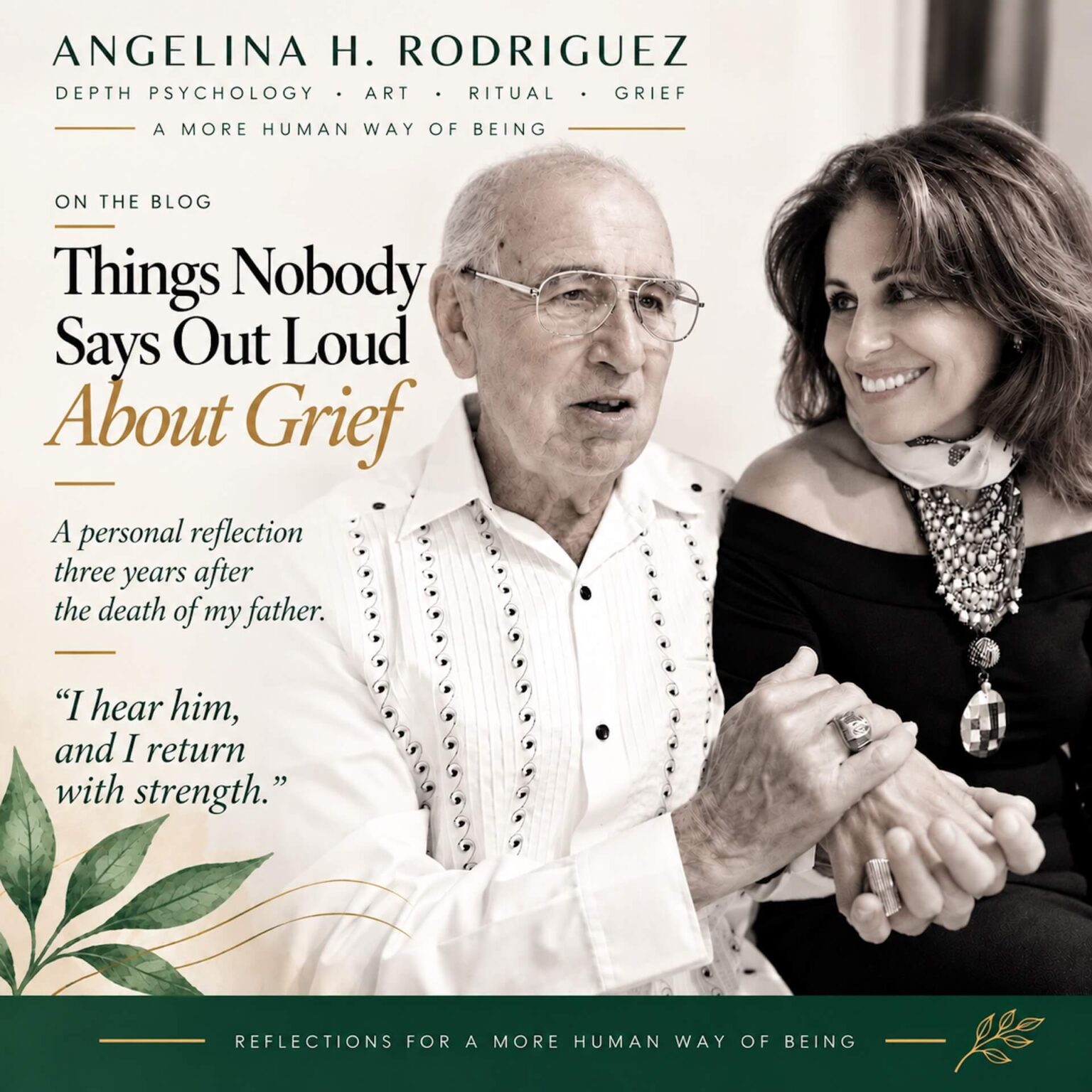
Three Years After My Father’s Death
This month marks three years since my father died.
Three years feels both long and impossibly short. I miss him every day.
I miss his beautiful mind—his intelligence, his poetry, his music. I miss his voice. But with time, I have realized that I am grieving something even larger than the things he loved or accomplished. I miss the particular way he inhabited the world.
My father lived with integrity, kindness, ambition, and an uplifting spirit. He believed in moving forward. Those qualities shaped me more deeply than I understood while he was alive.
Perhaps this is one of the things nobody says out loud about grief:
We don’t only grieve the person. We grieve the particular way that person made the world feel.
And yet, three years later, I am discovering something else.
Death ended my father’s physical presence. It did not end my relationship with him.
I have woven something of his spirit into my own life. In moments when I feel uncertain, discouraged, or tired, I hear him—not necessarily as a literal voice, but as an inner presence that has become deeply familiar.
I hear his encouragement. His determination. His insistence on continuing.
I hear him, and I return with strength.
Poetry Was Our First Language for Death
Long before I became a psychotherapist, art therapist, or depth psychologist, my father was quietly introducing me to one of the great mysteries that would eventually shape my life’s work: death.
Poetry was one of the ways he did it.
There was a lineage to this. My grandfather wrote and recited poetry to his children, and my father carried that tradition forward with me. As I later wrote in my doctoral research, I came to believe that my grandfather had given my father poetry as a way of approaching pain and suffering, and that my father, in turn, gave that same tool to me.
My father loved poetry and could recite entire poems from memory. One of his favorites was William Cullen Bryant’s Thanatopsis, a meditation on mortality and our return to the natural world. I remember him reciting it after dinner.
Imagine being a child and hearing:
“So live, that when thy summons comes to join
The innumerable caravan…”
I couldn’t possibly have understood then what those words would eventually mean to me.
But something entered my imagination.
My father was opening a threshold into the valley of death—not presenting death solely as something terrifying that must be avoided, but as part of the mystery of being alive.
In my dissertation, I wrote that he taught me to understand death as a natural process. His way of approaching frightening things encouraged me to draw strength and meaning from imagination. In my own words then: “He made me unafraid of death and unafraid of the dark.”
Only much later did I understand how profoundly those evenings had shaped me.
The Poem Followed Me
Thanatopsis followed me into adulthood.
Its final stanza became part of the psychological landscape from which my doctoral research eventually emerged. I wrote about its image of the “quarry-slave,” dragged unwillingly toward death, contrasted with Bryant’s invitation to approach mortality with trust and acceptance.
And then something remarkable happened.
The poem my father had once recited to me entered my own work with grieving people.
During the experiential portion of my doctoral research on the ofrenda ritual, I recited the final passage of Thanatopsis to participants as they entered a space of remembrance, art making, symbol, and relationship with their dead.
The words had traveled.
From my grandfather.
To my father.
To me.
And eventually, through me, into a ritual space created for others confronting loss.
I once described this inheritance in my dissertation with a phrase that still feels true:
I left home with poetry in my genome.
Today, I understand that sentence differently.
Maybe Grief Isn’t About Letting Go
We often speak of grief as something we must “move through,” as though successful grieving eventually deposits us safely on the other side.
My personal experience—and my years of work with grief, image, art making, and ritual—have made me question that assumption.
What if the task isn’t always to let go?
What if part of grieving is discovering how the relationship continues in another form?
The dead can remain psychologically present through dreams, memories, photographs, music, objects, gestures, stories, images, rituals—and through qualities of theirs that gradually become incorporated into our own lives.
This is one reason ritual matters.
When we make something in response to loss, we are not necessarily illustrating a feeling we already understand. Through selecting, arranging, remembering, touching, constructing, and creating, something previously without form can begin to take form.
Sometimes we come to know through making.
That is what I have witnessed in the creation of ofrendas. An object can become more than an object. An image can carry relationship. A ritual can create a container for something that ordinary language cannot adequately hold.
My research eventually led me to understand how deeply the stories and poems my father introduced to me had created archetypal images of death that continued to acquire psychological meaning throughout my life and eventually appeared in my art and work with bereavement.
But I understand something else now that I could not have understood while writing a dissertation about death.
I had studied what my father taught me about death before I had to learn how to live with his.
That changes everything.
Three Years Later
I no longer think of grief as something I am supposed to complete.
I carry my father’s absence, but I also carry what he gave me.
His intelligence.
His music.
His poetry.
His integrity.
His kindness.
His ambition.
His belief in moving forward.
And sometimes, unexpectedly, his voice.
There is one more detail from my dissertation that feels almost unbearably meaningful to me now. The final stanza of Thanatopsis—the poem my father recited from memory when I was young—is engraved on our family tomb.
The poem that once introduced me to death now marks the place where my father rests.
Perhaps this is another thing nobody says out loud about grief:
The people we love do not only leave memories behind. They leave language, gestures, values, images, music, stories—pieces of themselves that become woven into the people we are still becoming.
My father gave me poetry with which to contemplate death long before I knew I would devote part of my life’s work to understanding grief, image, and ritual.
Now his death has asked something different of me.
Not simply to understand death.
But to live with love after loss.
And when I need him most, I still know where to find him.
I hear him, and I return with strength.
About the Author
Dr. Angelina H. Rodriguez is a Depth Psychologist, Jungian Art Therapist, Dream Therapist, presenter, and researcher with more than 20 years of clinical experience. Her work explores dreams, symbolism, grief, ritual, creativity, and psychological transformation. She is the author of doctoral research examining the Ofrenda ritual as a bridge between art, memory, grief, and healing, and regularly presents on depth psychology, Jungian thought, dream work, and symbolic healing.