
Why certain dreams, images, and recurring experiences capture our attention—and what they may reveal about our inner lives.
There are images that refuse to leave us.
A dream that lingers long after waking. A particular color that repeatedly finds its way into our paintings. A childhood memory that unexpectedly returns decades later. A relationship that seems strangely familiar, even when the person is new.
Sometimes we recognize a pattern only after we have repeated it.
Other times, an image appears without explanation, leaving us wondering why it has captured our attention.
We may dismiss these experiences as coincidence, imagination, or simply the ordinary workings of memory.
But from a depth psychology perspective, they invite another question:
What if something within us is asking to be noticed?
The Psyche Does Not Always Speak in Words
As a depth psychotherapist, Jungian art therapist, and artist, I have spent much of my life exploring the relationship between images and the unconscious.
One of the fundamental insights of Carl Jung’s analytical psychology is that the unconscious expresses itself through symbolic imagery—in dreams, fantasies, myths, and creative experiences.
A symbol is not merely a picture representing something we already understand.
It may contain meanings that are not yet fully available to conscious awareness.
This distinction is important.
A sign generally points toward something identifiable. A symbol, in the Jungian sense, may suggest something larger, something that cannot be completely explained through a single definition.
Consider a tree.
To one person, it may evoke childhood and safety. To another, loneliness, resilience, or the passage of time. In a dream, a tree might appear uprooted, flowering, burning, or growing through the walls of a house.
The image is the same.
Its psychological significance is not.
Things nobody says out loud: Sometimes we are drawn to an image long before we understand what it means to us.
When an Image Appears Before Understanding
Throughout my life as an artist, I have often experienced the curious sensation of creating something without fully knowing why.
A line begins moving across the paper.
A shape emerges.
A color insists on being present.
What begins as an artistic gesture gradually becomes something recognizable—or perhaps something entirely unfamiliar.
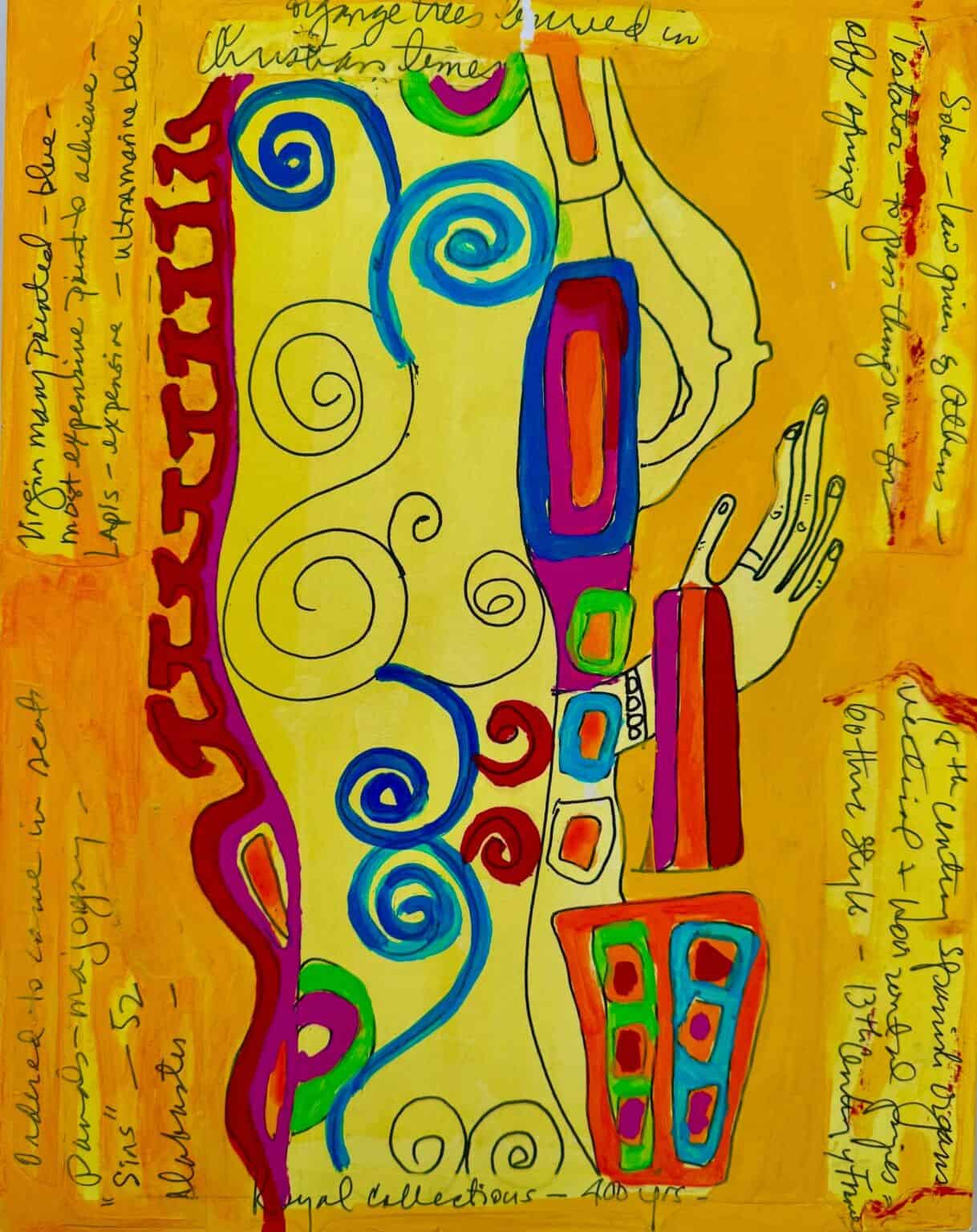
In my own work, I have explored spontaneous drawing through continuous, unbroken lines. At times, the movement becomes almost meditative. Rather than beginning with a predetermined image, I allow the line to travel, turn, intersect, and develop.
I am interested in what emerges when the need to control the outcome begins to soften.
In an earlier exploration of patterns, intuition, and artistic process, I reflected on how these spontaneous drawings could create opportunities to notice forms and emotional associations I had not consciously intended.
What fascinates me is not the suggestion that every line contains a hidden message.
It is the possibility that the creative process can bring us into contact with experiences, feelings, and associations that ordinary conversation may not immediately reach.
Sometimes we discover meaning in the act of creating.
Sometimes the meaning arrives much later.
And sometimes the image remains a mystery.
I have learned to respect all three possibilities.
The Patterns We Keep Repeating
Not every psychological pattern appears in a painting or a dream.
Some emerge in the way we live.
Perhaps you repeatedly find yourself taking responsibility for everyone else’s emotional well-being.
Perhaps you are drawn to relationships in which you feel unseen.
Perhaps you struggle to rest without feeling guilty, or repeatedly abandon your own desires to meet the expectations of others.
We often recognize these patterns intellectually long before we understand their emotional origins.
We tell ourselves, I know I do this. Why do I keep doing it?
From a depth psychological perspective, recurring patterns may be connected to earlier experiences, learned ways of relating, internal conflicts, or aspects of ourselves that have not yet been fully examined.
They are not necessarily evidence of some mysterious unconscious force. Nor does every repetition carry a profound symbolic message.
But when a pattern consistently creates suffering, curiosity may be more useful than condemnation.
Instead of asking only, How do I stop doing this?
We might also ask:
When did this pattern begin?
What has it protected me from?
What part of me continues to need it?
And who might I become if I no longer lived within it?
These are not always comfortable questions.
They may challenge the stories we have told ourselves about who we are.
Things nobody says out loud: Sometimes the patterns we most want to escape were once the very patterns that helped us survive.
When Dreams Bring Their Own Images
Dreams offer another fascinating encounter with the symbolic life.
Through my specialized training in Dream Tending™, I have become increasingly interested in approaching dream images not simply as puzzles to solve, but as experiences to encounter.
I once recorded a particularly vivid dream I called A Fencing Nightmare. It contained a rushing river, swords, an unfamiliar mythological figure, and a sudden shift from playfulness to danger.
The imagery was striking, but what interested me most was not finding a fixed interpretation. It was the experience of returning to those images and noticing what they continued to evoke.
In Jungian dreamwork, we explore images through personal associations, emotional responses, and active imagination. Rather than asking only, What does this dream mean? we might ask, Why has this particular image captured my attention?
Sometimes the dream’s significance lies not in finding an immediate answer, but in our willingness to remain curious about the image.
The Image as a Living Experience
In my practice as a Jungian art therapist, I have long been interested in the moment when an image becomes more than something to look at.
It becomes something to engage.
An individual might create a drawing and initially describe it as meaningless.
Yet as we explore the image together, they may begin noticing a particular figure, an unexpected color, or a relationship between shapes.
The image becomes a starting point for reflection.
This is one reason I value active imagination.
Developed by Jung, active imagination invites conscious engagement with images and figures arising from the unconscious. Through drawing, writing, dialogue, or other forms of creative expression, we may explore experiences that are difficult to articulate directly.
Rather than imposing an interpretation, we become curious about what the image evokes.
I sometimes think of this as learning another language.
Not a language with a dictionary of fixed meanings, but one that asks us to pay attention to emotion, association, imagination, and personal history.
Things nobody says out loud: An image does not have to be understood immediately to become psychologically meaningful.
The Symbols We Inherit—and the Ones We Create
Our symbolic lives are also shaped by culture.
We inherit stories, images, rituals, beliefs, and traditions long before we begin consciously examining them.
The mother.
The hero.
The wounded child.
The journey.
The home.
The sacred.
These images appear across mythology, religion, literature, art, and everyday experience, although their meanings vary across cultures and individuals.
As someone whose work has explored Mexican cultural traditions, I am particularly interested in the ways symbolic practices connect personal experience with collective meaning.
My doctoral research on the Ofrenda ritual examined how participants engaged photographs, flowers, personal belongings, and other meaningful objects through creative ritual.
The significance of these objects was not simply that they represented something.
It was that participants could interact with them, arrange them, reflect upon them, and create new relationships with the memories and emotions they evoked.
That research reinforced something I had already come to appreciate through artmaking:
Symbols are not only things we interpret. They are also things we experience.
Yet symbols do not belong exclusively to ritual or spiritual traditions.
They are present in the ordinary fabric of our lives.
In the photographs we preserve.
The objects we cannot discard.
The stories we repeatedly tell.
The images that appear in our dreams.
And the art we create without entirely understanding why.
What Is Asking for Your Attention?
We live in a culture that often rewards quick explanations.
We want to know what something means, why it happened, and how to resolve it.
But psychological understanding does not always unfold in a straight line.
Sometimes we need to remain with an image.
Sometimes we need to recognize a pattern without immediately trying to change it.
Sometimes we need to allow uncertainty long enough for a different understanding to emerge.
This does not mean that every dream predicts something, every coincidence carries a message, or every image conceals a hidden truth.
It means that our responses to images and experiences can offer valuable opportunities for self-reflection.
As an artist, I have learned that not every painting begins with a plan.
As a psychotherapist, I have learned that not every meaningful discovery begins with an explanation.
And as a student of depth psychology, I continue to be fascinated by the relationship between what we know about ourselves and what we have yet to discover.
Perhaps the question is not always, What does this symbol mean?
Perhaps the more interesting question is:
Why does this particular image, pattern, or experience continue to matter to me?
And what might I discover if I gave it my attention?
Things nobody says out loud:
The psyche does not always reveal itself through answers. Sometimes it begins by showing us what we have not yet learned to see.
About the Author
Dr. Angelina H. Rodriguez, Ph.D., LPC-AT/S, ATR-BC, is a depth psychotherapist, Jungian art therapist, artist, researcher, and speaker with more than 20 years of clinical experience. Her work explores the intersection of depth psychology, dreams, symbolic imagery, active imagination, creativity, cultural traditions, and psychological transformation.
She holds specialized training in Dream Tending™ and has conducted doctoral research examining the Ofrenda ritual through Art-Based Research and Jungian depth psychology.
Website: https://therapybyangelina.com/