
Memory, grief, and the relationships that continue after death
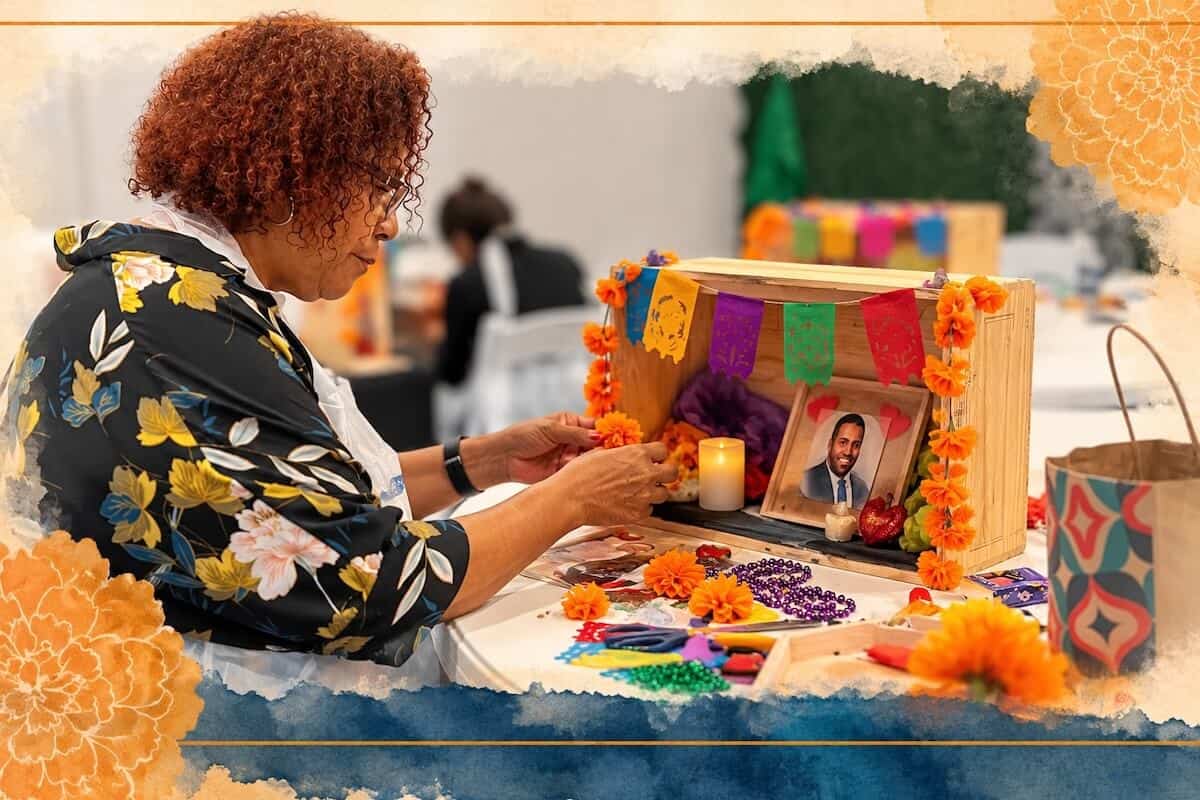
As Día de los Muertos approaches, familiar images begin to appear: brilliant orange marigolds, flickering candles, photographs, papel picado, favorite foods, and beautifully arranged altars.
But here is something we don’t often say out loud: remembering someone who has died is not only about looking back. Sometimes it is about discovering how the relationship continues.
The Ofrenda is not simply something to look at. It is something we create, enter into, and experience.
Rooted in Mexican traditions of Día de los Muertos, the Ofrenda is a ritual space created to remember and honor those who have died. Photographs, flowers, food, personal belongings, candles, and other meaningful objects are intentionally gathered and arranged. Each may hold a memory, a story, or a connection to the person being remembered.
The process asks us to do something very human: to make a place for the dead within the lives of the living.
Why Do We Create an Ofrenda?
Grief changes a relationship, but it does not necessarily end it.
After someone dies, we continue to carry memories, conversations, emotions, stories, and pieces of that person within us. Sometimes those connections are comforting. Sometimes they are painful. Often, they are both.
Creating an Ofrenda gives those memories and relationships a physical place to emerge.
A photograph may evoke a story.
A favorite food may awaken a sensory memory.
An object may represent something that words cannot fully express.
A flower, candle, color, or symbol may suddenly carry meaning we did not consciously recognize before.
Through the act of choosing, arranging, remembering, and reflecting, something internal becomes visible.
Ritual Gives Grief a Form
As a depth psychologist and art therapist, I am particularly interested in what happens psychologically when grief is given image, symbol, and ritual.
Grief can be difficult to contain in words alone.
Ritual offers another language.
Through symbolic action, we are able to engage memories and emotions that may otherwise remain difficult to articulate. Creating an Ofrenda can become an active encounter with memory—one that involves the hands, the senses, imagination, emotion, and the physical presence of meaningful objects.
The Ofrenda becomes more than a collection of things.
It becomes a container for memory and relationship.
Remembering Is Also Relating
One of the most meaningful ideas within contemporary grief psychology is that healing does not require us to sever our relationship with someone who has died.
The relationship changes.
We may continue it through memory, stories, traditions, dreams, objects, places, photographs, rituals, and the ways that person continues to influence who we are.
The Ofrenda provides a tangible space for that continuing relationship.
Perhaps this is one reason the ritual can feel so powerful.
We are not simply remembering that someone once existed.
For a moment, we are intentionally making room for that relationship again.
An Invitation This October
Throughout October, I will be sharing short excerpts from my documentary and reflections on the Ofrenda ritual—its traditions, symbols, relationship to grief, and the psychological experience of creating one.
I will also be offering presentations and experiential opportunities this month where we can explore the Ofrenda ritual more deeply as we approach Día de los Muertos.
My hope is that these conversations invite us to look beyond the beautiful altar and consider the ritual taking place within and around it.
Because perhaps the deeper question is not simply:
How do we remember those who have died?
But:
How do we continue to carry a relationship with them as we continue living?
About the Author
Dr. Angelina H. Rodriguez is a Depth Psychologist, Jungian Art Therapist, Dream Therapist, presenter, and researcher with more than 20 years of clinical experience. Her work explores dreams, symbolism, grief, ritual, creativity, and psychological transformation. She is the author of doctoral research examining the Ofrenda ritual as a bridge between art, memory, grief, and healing, and regularly presents on depth psychology, Jungian thought, dream work, and symbolic healing.